
Most older adults want to remain in their own homes for as long as possible. But a familiar home is not automatically a safe home.
Changes in balance, strength, mobility, vision, hearing, memory, and medication use can turn ordinary household features into potential hazards. A loose rug, poor lighting, an unstable chair, or the absence of bathroom grab bars may not seem serious—until someone falls.
According to the Centers for Disease Control and Prevention, more than 14 million adults age 65 and older—approximately one in four—report falling each year. Falls are also the leading cause of injury among older adults.
Many falls can be prevented. A professional senior home safety assessment helps families identify concerns before an injury or emergency occurs.
Home Care Is Where the Heart Is Earns Senior Home Safety Specialist® Certification
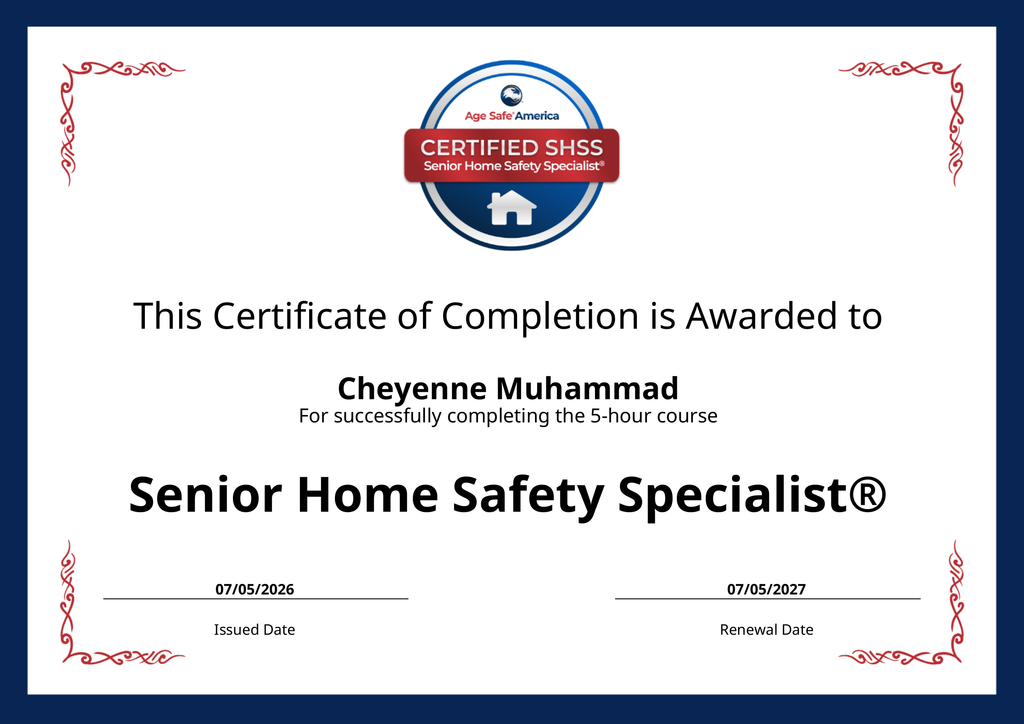
Home Care Is Where the Heart Is is proud to announce that Cheyenne Muhammad, RN, Administrator, has earned the Senior Home Safety Specialist® certification through Age Safe® America.
This nationally recognized credential provides specialized training in senior home safety, fall prevention, aging-in-place modifications, fire safety, accessibility, dementia-related concerns, emergency planning, home technology, and other risks affecting older adults.
Combined with more than 20 years of nursing experience, this additional training strengthens our ability to help older adults and their families make informed decisions about safety at home.
What Is a Senior Home Safety Assessment?
A senior home safety assessment is a structured evaluation of the areas where an older adult lives and completes daily activities.
The purpose is not to criticize how someone maintains their home or pressure the family into making expensive renovations. The purpose is to identify practical risks, understand the older adult’s needs, and recommend reasonable changes that may improve safety and independence.
Our RN-led Home Safety and Aging-in-Place Assessment takes approximately 80 minutes and considers the person as well as the physical environment.
What Areas of the Home Are Reviewed?
Entrances and Walkways
We look at the path into and out of the home, including steps, handrails, thresholds, uneven surfaces, lighting, and the accessibility of commonly used entrances.
Living Areas
Furniture placement, electrical cords, floor coverings, clutter, walking paths, seating stability, and lighting may affect a person’s ability to move safely through the home.
Bedrooms
The assessment considers access to the bed, nighttime lighting, pathways to the bathroom, telephone access, floor hazards, and whether the bed’s height supports safer transfers.
Bathrooms
Bathrooms are an important part of a senior home safety assessment because wet surfaces and transfers can increase fall risk. We may evaluate tub and shower access, grab-bar placement, nonslip surfaces, toilet height, lighting, walking space, and frequently used personal-care items.
Kitchen and Dining Areas
We assess whether commonly used items can be reached without unsafe bending, climbing, or stretching. We may also review appliance safety, lighting, floor conditions, and the older adult’s ability to prepare or access meals safely.
Stairs and Hallways
Stairways and hallways are reviewed for lighting, secure handrails, clear walking paths, visible step edges, and loose flooring.
Emergency Readiness
A safe home should also support a timely response during an emergency. The assessment may consider smoke and carbon monoxide alarms, emergency contacts, accessible telephones, exit routes, and the older adult’s ability to obtain help.
The National Institute on Aging also recommends measures such as improving lighting, securing or removing area rugs, installing bathroom grab bars, and using nonslip surfaces in wet areas.
Is the Assessment Only for Someone Who Has Already Fallen?
No. The best time to evaluate home safety is before a fall or emergency.
A senior home safety assessment may be particularly valuable when:
- An older adult has recently fallen or nearly fallen
- A family has noticed changes in balance or mobility
- Someone is returning home after hospitalization or rehabilitation
- A new diagnosis affects memory, strength, or judgment
- An older adult begins using a cane, walker, or other mobility device
- A caregiver is worried about leaving the person alone
- The family is planning for long-term aging in place
- The home has not been evaluated as the person’s needs have changed
Aging in place requires planning. The goal is to help the home continue supporting the person—not wait until the environment becomes a barrier.
Does Every Recommendation Require Remodeling?
No. Some of the most meaningful improvements are relatively simple.
Recommendations might include:
- Removing or securing loose rugs
- Improving lighting
- Clearing walking paths
- Rearranging frequently used items
- Adding night lights
- Replacing unstable furniture
- Installing properly positioned grab bars
- Adding nonslip surfaces
- Improving access to emergency contact information
Other situations may require discussion with qualified contractors, occupational therapists, medical providers, or other professionals. The family can decide which recommendations to address and in what order.
A Home Safety Assessment Is About Preserving Independence
Families sometimes avoid discussing safety because they are afraid an older adult will think they are trying to take away control.
A thoughtful assessment should do the opposite.
It should help the older adult participate in decisions about the home, identify what matters most to them, and find ways to support continued independence. The objective is not to eliminate every possible risk. It is to recognize meaningful concerns and make informed choices.
Schedule a Home Safety and Aging-in-Place Assessment
Home Care Is Where the Heart Is provides RN-led Home Safety and Aging-in-Place Assessments for older adults and families in Douglasville and surrounding Georgia communities.
If you are concerned about a parent living alone, preparing for a hospital discharge, or simply trying to plan ahead, a home safety assessment can provide a clearer starting point.
Learn more about our Home Safety and Aging-in-Place Assessment, review our home care services, or submit an inquiry to speak with us.
Cheyenne Muhammad, RN
Administrator
Home Care Is Where the Heart Is.